















 Ingredient Database


 Allergen Filter
 Allergen Filter


 BY SKINSAFE MEDICAL EDITORIAL TEAM
 AUG 17, 2026
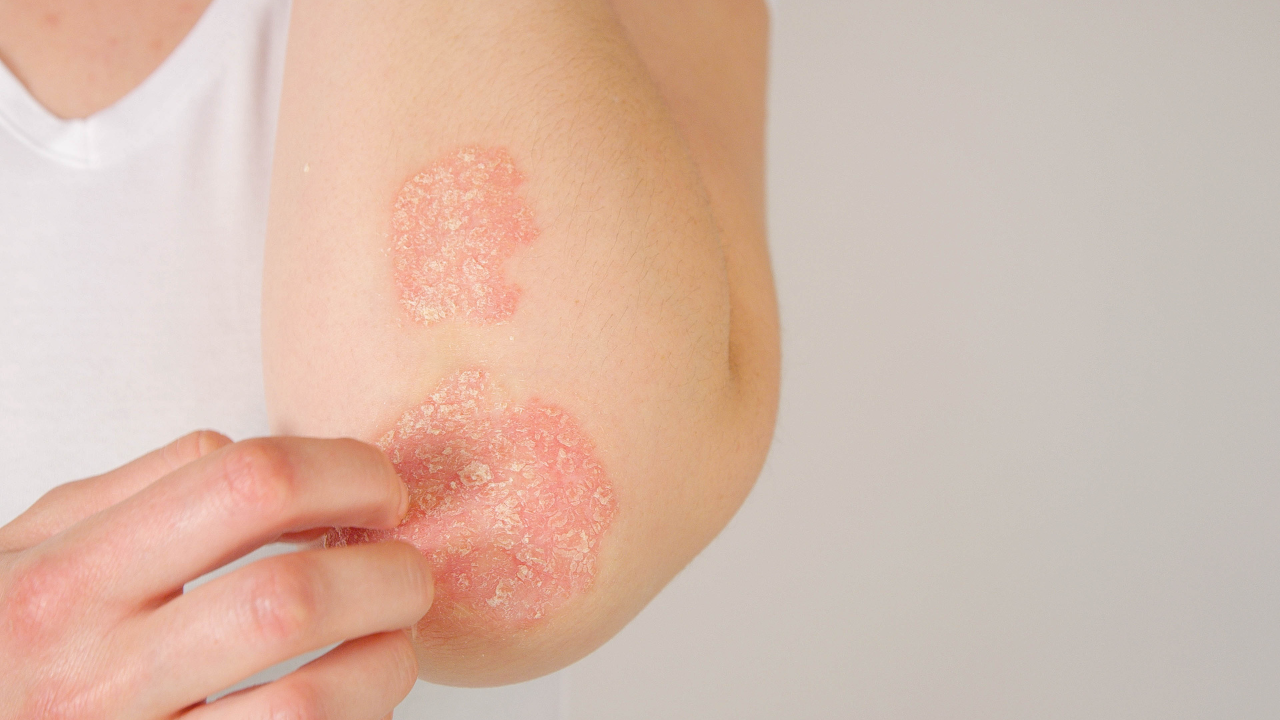
August is Psoriasis Awareness Month — a good time to clear up a common source of confusion: how psoriasis differs from eczema, and whether the two need the same skin care.
Two Conditions That Look Alike But Aren't
Both cause red, scaly, itchy rashes that wax and wane over time. But they are driven by different immune pathways. In psoriasis, immune signals push skin cells to multiply far too fast, building up thick plaques. In eczema (atopic dermatitis), a different set of immune signals combines with a leaky, weakened skin barrier that lets moisture out and irritants and allergy-causing substances in.
How to Tell Them Apart
Appearance: Psoriasis plaques are thick, raised, and sharply bordered, often with silvery-white scale. On darker skin tones they may look violet, brown, or gray. Eczema patches have softer edges that blend into normal skin, with finer scale.
Location: Psoriasis favors the outside of elbows and knees, the scalp, lower back, and belly button. Eczema favors the inner creases of elbows and behind the knees, plus the face and neck.
Sensation: Both itch, but eczema can itch more intensely. Psoriasis often burns or feels sore.
Nails and joints: Psoriasis can cause nail pitting, thickening, or lifting, and can involve the joints (psoriatic arthritis). Eczema does not.
Other health links: Eczema travels with asthma, hay fever, and food allergies. Psoriasis is linked to heart disease, high blood pressure, diabetes, obesity, and depression.
Age of onset: Eczema often starts in infancy; psoriasis more often begins in young adulthood, though it can start at any age.
Do You Need Different Products?
The daily basics overlap, but psoriasis has some options specific to it.
The same for both:
Moisturize generously and often, even when skin looks clear. Thick creams and ointments work better than thin lotions. Apply within a few minutes of bathing. Vanicream Moisturizing Skin Cream is one option.
Use gentle, fragrance-free cleansers. Fragrance and essential oils irritate both conditions. For example, La Roche-Posay Toleriane Hydrating Gentle Cleanser.
Keep baths short and lukewarm, and pat dry rather than rubbing.
No brand is proven best. The fragrance-free moisturizer you will actually use consistently is the right one. For individuals with particularly sensitive skin, avoiding common allergy-causing preservatives can be helpful too. This can be done easily by choosing products that are listed as SkinSAFE 100.
Specific to psoriasis:
Salicylic acid dissolves and lifts thick scale, and helps medicated creams penetrate. It is most useful on plaques and the scalp. It is generally too irritating for patients with eczema. Examples include Nizoral Psoriasis Relief Cream with Salicylic Acid 3% and Neutrogena T/Sal+ Anti-Dandruff Shampoo with Salicylic Acid 3%.
Coal tar slows skin cell overproduction and reduces scaling and itch, especially in scalp shampoos. Drawbacks are odor, staining, and irritation. Coal tar can be prescribed by your dermatologist and is available in several over-the-counter products like DHS Tar Shampoo.
Urea and lactic acid hydrate while softening thick, scaly skin. Options include
Salicylic acid and coal tar are the two ingredients the FDA recognizes for over-the-counter psoriasis treatment.
For scalp psoriasis, leave medicated shampoo on for several minutes before rinsing, and work it into the scalp rather than just the hair.
Be cautious with harsh scrubs, loofahs, strong astringents, and aggressive peels. Psoriasis can appear at sites of skin injury, so avoid scrubbing and picking or scraping off scale.
Prescription Treatments Also Differ
For psoriasis, topical steroids are first-line and work better when paired with a vitamin D analogue such as calcipotriene. Other options include tazarotene and newer once-daily nonsteroid creams like tapinarof and roflumilast. Widespread disease may need light therapy, systemic medications, or biologics.
For eczema, topical steroids are also first-line, but the next steps differ — calcineurin inhibitor creams and ointments (tacrolimus, pimecrolimus), crisaborole cream, ruxolitinib cream, or dupilumab injections.
Because the immune pathways differ, a treatment that helps one condition may not help the other. Getting the right diagnosis matters.
Living Well with Psoriasis
Use prescription treatments as directed, even as skin improves. Don't mix medication into your moisturizer unless told to — it dilutes the medicine.
Know your triggers. Stress, infections (especially strep throat), cold dry weather, skin injury, and certain medications can all trigger psoriasis, but triggers vary between individuals.
Lifestyle counts. A healthy weight, avoiding tobacco, and limiting alcohol support better control — though they don't replace treatment.
Think beyond the skin. Ask your primary care provider about screening for blood pressure, cholesterol, and blood sugar. Report joint pain or morning stiffness lasting over 30 minutes, since untreated psoriatic arthritis can damage joints permanently. Depression and anxiety are common and worth raising with your care team.
See a dermatologist if over-the-counter care isn't working, if plaques are widespread or on sensitive areas, if nails or joints are involved, if sleep or mood is affected, or if you're unsure which condition you have.
References
Elmets CA, Korman NJ, Prater EF, et al. Joint AAD-NPF guidelines of care for the management and treatment of psoriasis with topical therapy and alternative medicine modalities for psoriasis severity measures. J Am Acad Dermatol. 2021;84(2):432-470.
Frazier W, Schneider L, Chu DK. Atopic dermatitis: updated guidelines from the AAAAI/ACAAI Joint Task Force on Practice Parameters. Am Fam Physician. 2024;110(4):411-412.
Armstrong AW, Read C. Pathophysiology, clinical presentation, and treatment of psoriasis: a review. JAMA. 2020;323(19):1945-1960.
Le Cleach L, Afach S, Veroniki AA, et al. Topical treatments for chronic plaque psoriasis. Cochrane Database Syst Rev. 2026.